Google Ads vs. Meta Ads: Where Should You Spend Your Next $10,000?
Published on January 11, 2026

Yash Shinde
Jan 11, 2026 • 9 min read
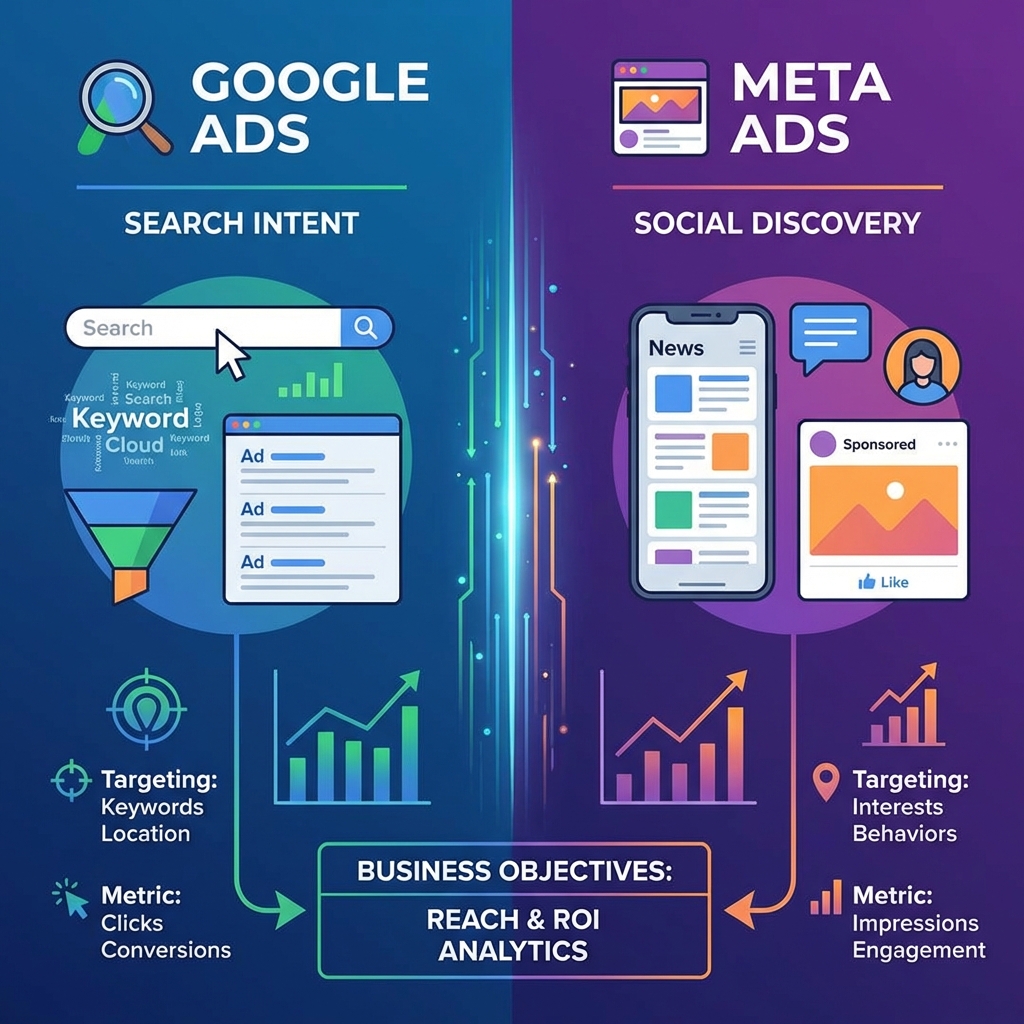
Founders often ask us: "Which platform is better?" The truth is, it's not about which platform is better in isolation, but which one fits your business model, buyer journey, and budget right now. At VSS, we use a data-driven framework to decide where to allocate spend for maximum ROI, and the answer differs significantly by industry, product type, and growth stage.
1. Understanding the Intent Gap
The primary difference between Google and Meta is User Intent. Google is for when people are actively searching for a solution they already know they need. Meta is for discovering a solution they did not know existed yet. This distinction drives everything: ad format, creative strategy, landing page design, and how you measure success.
- Choose Google Ads if: You have a solution-based product with established search demand (e.g., "SEO Agency in Mumbai" or "GST software for manufacturers"). You want to capture high-intent users who are actively evaluating options and ready to buy. Check our Mumbai SEO guide for more on high-intent search strategy.
- Choose Meta Ads if: Your product is visual, lifestyle-oriented, or solves a problem buyers don't yet know they have. You want to build brand awareness, retarget website visitors, or target specific demographics and interest categories rather than keywords. See our Thane E-commerce strategy for D2C Meta examples.
Google Ads vs Meta Ads: Cost Benchmarks for Indian Businesses in 2026
Understanding the cost landscape for your industry helps set realistic expectations before you commit budget. These are approximate benchmarks from campaigns we manage across Maharashtra markets:
| Industry | Google CPC (Rs.) | Meta CPC (Rs.) | Best Platform |
|---|---|---|---|
| B2B SaaS / Tech | 40-120 | 8-25 | Google (intent) |
| D2C / E-commerce | 15-45 | 3-12 | Meta (discovery) |
| Real Estate | 60-180 | 10-30 | Both (hybrid) |
| Professional Services | 30-90 | 5-18 | Google (intent) |
| Education / Coaching | 20-60 | 4-15 | Both (hybrid) |
Note: CPC alone does not determine platform ROI. A Rs. 100 Google click from someone searching "hire digital marketing agency Pune" may convert at 8%, while a Rs. 10 Meta click from interest-targeted browsing may convert at 0.5%. Cost-per-lead is the metric that matters, not cost-per-click.
Campaign Setup: What Works on Google Ads for Indian Service Businesses
The most effective Google Ads structure for Indian service businesses in 2026 combines Responsive Search Ads (RSA) targeting exact and phrase match keywords with a tightly themed ad group structure. Each ad group should contain 8-15 closely related keywords with a single theme, never a broad mix. This improves Quality Score, reduces CPC, and makes performance analysis actionable.
Remarketing Lists for Search Ads (RLSA) are underused by most Indian advertisers. By bidding 30-50% higher on users who have already visited your website or watched your YouTube content, you recapture warm audiences at a much lower CPL than cold search campaigns. Combined with local service campaigns for Google Business Profile leads, a well-structured Google Ads account can deliver consistent lead flow with CPLs that improve month over month as the account accumulates data.
2. The Hybrid Intent Catch Strategy
The most successful brands do not choose one platform over the other. They use a deliberate hybrid model. Meta drives awareness and market creation; Google Search Ads (combined with Hub and Spoke SEO) captures the branded searches that follow Meta exposure. A prospect sees your Meta ad on Monday, thinks about it, then searches "VSS agency Pune reviews" on Thursday. Without Google Ads capturing that branded search, a competitor could intercept your warm lead.
For brands with limited budgets, the phased approach works best: start with Google Search Ads for immediate high-intent leads, build organic authority through content and SEO in months 1-6, then introduce Meta Ads for brand building and top-of-funnel once the organic foundation is established and you have social proof to support Meta creative.
Meta Ads Creative Strategy for Indian D2C Brands
Meta's algorithm rewards content that generates genuine engagement before it asks for a click. For Indian D2C brands, the highest-performing Meta ad formats consistently are: short-form video (15-30 seconds) featuring real customers using products in recognisable Indian contexts, UGC-style creative that feels native rather than produced, and carousel ads showing multiple product use cases with price anchoring.
Regional language targeting on Meta is significantly underutilised by Maharashtra brands. Running Marathi-language creative to a Maharashtra-specific audience, alongside the standard English creative, consistently produces 20-35% lower CPM and higher engagement rates because the content feels locally relevant. For brands targeting Tier 2 cities like Nagpur, Aurangabad, or Kolhapur, Marathi creative often outperforms English creative substantially.
3. Don't Waste Traffic: Optimize Your Pages
No matter where your traffic comes from, it is wasted if your landing page does not convert. We have seen brands double their effective ROI without changing their ad spend by making 5 targeted landing page tweaks. Before scaling your paid spend, ensure your conversion infrastructure is ready. A 3% conversion rate landing page receiving Rs. 1,00,000 of monthly ad spend generates 30 leads. The same budget with a 7% conversion rate generates 70 leads. The 7% page delivers 133% more leads for zero additional cost.
"Google captures demand. Meta creates demand. Scaling requires both."
Final Verdict
For most B2B and SaaS firms, Google Search Ads is the safer first investment because search intent is already established. For B2C and e-commerce brands, Meta is often the primary growth engine because discovery-driven shopping matches the platform's format. For real estate, education, and professional services, a hybrid approach from month one captures both active searchers and aspirational browsers. If you want a custom audit of your current ad performance with specific recommendations for your Maharashtra market and industry, visit our Contact Page.
Frequently Asked Questions
- Should Indian B2B companies choose Google Ads or Meta Ads?
- Indian B2B companies should prioritize Google Ads because it captures demand from buyers who are actively searching for solutions. A decision-maker searching 'CRM software for manufacturing companies India' is ready to evaluate vendors. Meta Ads can support B2B with awareness campaigns, but for direct lead generation with commercial intent, Google Search Ads consistently deliver lower cost-per-qualified-lead for Indian B2B businesses.
- Which platform has lower cost-per-click in India: Google Ads or Meta Ads?
- Meta Ads typically have lower cost-per-click in India, often ranging from Rs. 2 to Rs. 15 per click versus Google Search Ads at Rs. 15 to Rs. 80 per click for competitive keywords. However, click quality differs significantly. Google clicks come from people with active buying intent, while Meta clicks require more nurturing. For conversion-focused campaigns, Google's higher CPC is often justified by superior lead quality.
- Can a small business in India run both Google Ads and Meta Ads on a limited budget?
- Yes, but prioritization matters. With a monthly budget under Rs. 30,000, focus 70 percent on the channel that best matches your buyer's journey. Service businesses with known search demand should lean toward Google; D2C and lifestyle brands should lean toward Meta. Once you identify your highest-converting channel, you can gradually introduce the second platform to cover the full funnel.
Related Reading
Landing Page Tweaks for Ads
How to ensure your paid traffic doesn't leak out of your funnel.
Performance Marketing in Pune
A look at how Pune-based startups scale using paid acquisition.