
The "Hub & Spoke" SEO Model: How to Own Your Niche
Published on January 13, 2026

Yash Shinde
Jan 13, 2026 • 12 min read
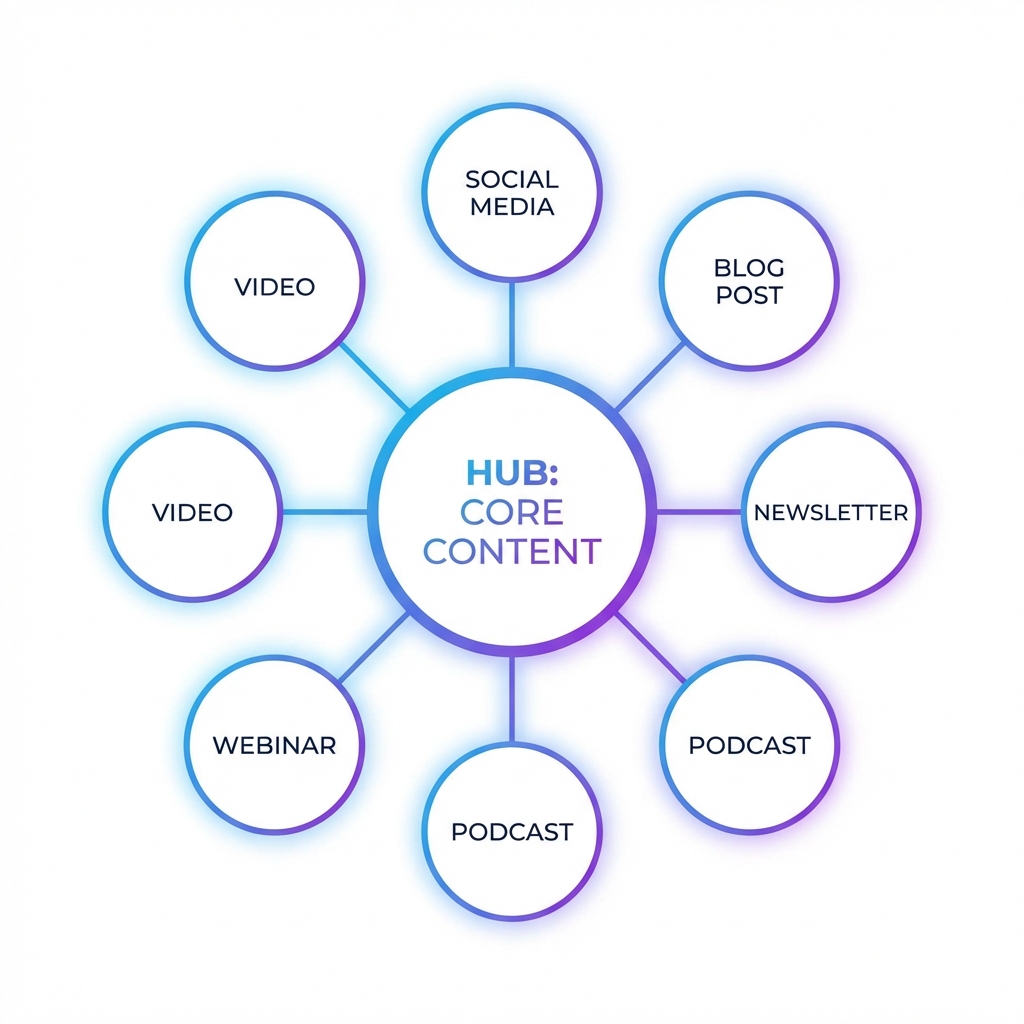
In the high-stakes world of Modern SEO, one strategy consistently stands out for its ability to build authority and dominate competitive niches: the Hub and Spoke model. While most businesses publish isolated blog posts and hope for rankings, the brands that dominate search results are building interconnected content ecosystems that signal deep topical expertise to Google at every level.
What is the Hub and Spoke Model?
Also known as content clusters or topic clusters, this model is a systematic method of organising your website's architecture to help search engines understand your topical authority. At VSS, we use this framework to turn scattered blog posts into a powerful compound growth engine. It consists of two main components:
- The Hub (Pillar Page): A comprehensive, high-level guide on a broad topic (e.g., "Digital Marketing Strategy for Indian Businesses"). This page should answer the "what" and "why" of a topic thoroughly, ideally 2,500-4,000 words, and serve as the canonical reference for the subject on your site.
- The Spokes (Cluster Content): Multiple, more specific articles that explore sub-topics in depth (e.g., "Mumbai SEO Strategy" or "Scaling Content with AI"). These answer the "how-to" questions and capture long-tail search demand.
The critical element that makes this model work is bidirectional internal linking. Every spoke must link back to the hub using keyword-rich anchor text, and the hub must link out to every spoke. This creates a "PageRank loop" that concentrates authority across the entire cluster and tells Google that these pages are thematically related and mutually reinforcing.
Why the Hub and Spoke Model Outperforms Standalone Blog Posts
Publishing isolated blog posts is the way most websites approach content marketing, and it is why most websites see modest, unpredictable organic growth. A standalone post on "SEO for Pune businesses" competes on its own. But a hub page on "Digital Marketing for Pune Businesses" supported by 10 spoke articles covering local SEO, Google Ads, content strategy, landing page optimisation, and each major Pune industry creates a content cluster that ranks for hundreds of keyword variations simultaneously.
Data from multiple client campaigns shows that pages belonging to well-structured topic clusters receive 2-3x more organic traffic than equivalent standalone pages. Hub pages with 8 or more supporting spokes typically rank for 3-5x more keyword variations than pages with no cluster structure. The compounding effect means that each new spoke you add increases the hub's ranking capability, not just its own.
For Indian businesses competing in markets like Mumbai, Pune, Nagpur, and Thane, the Hub and Spoke model is particularly powerful because it allows you to build neighbourhood-level and industry-level specificity into your content architecture, the exact type of signals that Google rewards with strong local pack and organic rankings.
Why It Works: The Google Perspective
Google has moved well beyond keyword matching. Google's algorithms now evaluate E-E-A-T: Experience, Expertise, Authoritativeness, and Trustworthiness. A single blog post, no matter how well-written, struggles to demonstrate all four signals. A content cluster does it systematically. The hub demonstrates comprehensive expertise. The spokes demonstrate real-world experience with specific sub-topics. The backlinks earned by the cluster demonstrate authority. And the depth of coverage builds user trust.
Google's Helpful Content system, updated repeatedly since 2022, specifically rewards content that demonstrates "first-hand expertise and a depth of knowledge." A topic cluster that covers a subject from 10-15 angles clearly signals first-hand expertise in a way that a single page cannot. When combined with strong E-E-A-T signals (author pages, credentials, and citations from authoritative sources), a well-built content cluster becomes almost impossible to displace from its rankings.
This approach is particularly effective when combined with Performance Marketing strategies, as it ensures that the organic traffic you capture is highly qualified and ready for conversion on optimised landing pages. The synergy between organic authority and paid acquisition creates a compounding growth engine where each channel reinforces the other.
Hub and Spoke Architecture for Indian Digital Marketing
Here is how VSS structures content clusters for Indian digital marketing clients. The hub page targets the primary commercial keyword at city or service level. Spoke pages are divided into three types: location spokes (targeting neighbourhoods or adjacent cities), audience spokes (targeting specific industries or business types), and tacticial spokes (targeting specific strategies or tools).
For a Pune-based digital agency hub on "digital marketing services Pune," a well-structured cluster might include: location spokes for Kothrud, Baner, Hinjewadi, Kharadi, and Wakad; audience spokes for startups, D2C brands, real estate developers, and educational institutes; and tactical spokes on SEO, Google Ads, social media, and landing page optimisation. This architecture covers the search intent landscape comprehensively and creates opportunities to rank for hundreds of queries with meaningful commercial value.
Common Hub and Spoke Mistakes to Avoid
- Thin spoke content: Spokes under 800 words rarely rank. Each spoke should be a genuinely complete answer to its specific sub-topic question.
- Missing bidirectional links: If spokes link to the hub but the hub does not link back to spokes, the PageRank loop is broken. Both directions are required.
- Duplicate angles: Two spokes covering essentially the same sub-topic from slightly different angles create cannibalisation. Each spoke needs a clearly distinct search intent.
- No hub update cycle: As you add spokes, the hub must be updated to link out to new spokes and to incorporate insights from the spoke content. A hub page not updated in 12 months loses freshness signals.
- Starting with the spokes: Many teams write spokes before the hub exists. Always publish the hub first, then build spokes around it. The hub sets the semantic authority that spokes inherit.
A 5-Step Implementation Checklist
- Identify your Core Topic: Choose a broad topic central to your business with clear commercial search intent. Check our Case Studies to see how we have done this for clients across Maharashtra.
- Perform Gap Analysis: Use Google Search Console and keyword research tools to find the long-tail questions and sub-topics your competitors are missing. These gaps are your opportunity to establish authority with less competition.
- Create the Hub: Write a 3,000 or more word comprehensive guide that acts as the definitive resource on the topic. Include a clear structure, data and statistics, expert insights, and links to all planned spokes as they are published.
- Develop the Spokes: Create 8-12 specific articles, each targeting a distinct sub-topic angle. If you need to move fast, learn how to scale content with AI without losing brand voice or quality.
- Internal Linking: All spokes must link back to the hub with keyword-rich anchor text, and the hub must link out to all spokes. Review and update the entire cluster every quarter to add new spokes, refresh outdated information, and maintain internal link integrity.
"Authority is not built by a single page, but by a network of high-quality content that solves the user's entire journey from discovery to decision."
Conclusion
The Hub and Spoke model is a medium-to-long-term investment, but its results compound in a way that one-off blog posts never will. By building a network of interconnected content, you create a ranking moat that competitors will find extremely difficult to breach. The businesses that implement this framework in 2026, while many of their competitors are still publishing isolated posts, will enjoy sustained organic visibility for years. Ready to implement this in your city? Explore our local guides for Mumbai and Nagpur to see how hub and spoke clusters are built for real local markets.
Frequently Asked Questions
- What is the Hub and Spoke SEO model?
- The Hub and Spoke SEO model is a content architecture strategy where one comprehensive pillar page (the hub) covers a broad topic in depth, and multiple focused supporting articles (the spokes) each address specific subtopics. All spoke pages link back to the hub with relevant anchor text, and the hub links out to each spoke. This structure signals topical authority to Google and helps the entire cluster rank higher than any single standalone page would.
- How many spoke articles do you need to build effective topical authority?
- A minimum of 5 to 8 well-researched spoke articles is needed to begin establishing topical authority around a hub. The ideal number depends on the breadth of the topic. For a competitive topic like 'SEO for Indian businesses', 15 to 25 supporting articles covering specific cities, industries, and tactics creates a content moat that is extremely difficult for competitors to replicate quickly.
- How long does the Hub and Spoke model take to produce ranking results?
- The Hub and Spoke model is a medium-to-long-term strategy. Most websites begin to see improved rankings for spoke articles within 60 to 90 days of publishing the cluster. The hub page typically shows the most significant ranking improvements after 3 to 6 months once Google has crawled all the spoke pages and recognized the topical depth of the cluster. Consistent internal linking and regular content updates accelerate the timeline.
Related Reading
How to Scale Content 10x with AI
Learn the exact workflow we use to fuel our Hub & Spoke clusters.
5 Landing Page Tweaks for SEO Traffic
Ensure the traffic your Hub & Spoke model generates actually converts.