How to Rank in Google AI Overviews: The 2026 SEO Playbook for Indian Businesses

Yash Shinde
Mar 16, 2026 • 13 min read
Something shifted in Indian search results in late 2025 — and most agencies in Pune, Mumbai, and Bengaluru are still catching up. Google AI Overviews (AIO) are now appearing on roughly 47% of all Google searches in India, synthesizing answers before a single user ever clicks a website.
The businesses that understand how to get cited inside these AI summaries are quietly capturing brand impressions at scale. The ones still optimizing for "position #1" the old way are watching their click-through rates erode.
This is the exact framework we use at VSS to help our clients stay visible — and get cited — in the AI-first search era.
What You'll Learn
- What Google AI Overviews are and why they matter for Indian businesses
- Why your competitors in Pune are already losing traffic to AIO
- The 5-pillar framework to get cited in AI Overviews
- How E-E-A-T directly determines your AIO eligibility
- A practical content checklist you can apply this week
What Are Google AI Overviews — And Why Should Pune Businesses Care?
Google AI Overviews (AIO) — previously called Search Generative Experience (SGE) — are AI-generated answer panels that appear above organic results for a growing range of queries. They are powered by Google's Gemini model and pull citations from multiple websites to construct a synthesized response.
Here's what makes this critical for businesses in Pune and across Maharashtra:
- Zero-click risk is real. For informational queries like "how does SEO work" or "what is performance marketing," AIO answers the question in full. The user doesn't need to click.
- But citation = brand exposure. When Google's AI cites your website as a source, your logo, domain, and a snippet appear inside the AIO box — above all organic results. That's prime real estate.
- Commercial queries still drive clicks. Searches like "best digital marketing agency Pune" or "SEO services cost India" trigger AIO panels that still link to specific businesses — this is where you want to be.
The bottom line: AIO doesn't make SEO irrelevant. It restructures what "winning" looks like. The winners are businesses with deep, credible, well-structured content.
Why Most Competitors in Pune Are Invisible in AI Overviews
We've audited dozens of Indian business websites since AIO rolled out. The pattern is consistent. Agencies and brands that are invisible in AI Overviews share these failure points:
- Thin, keyword-stuffed content. Pages optimized purely for keyword density — "digital marketing agency Pune" repeated 18 times — signal low expertise to Gemini's models. Google's AI sources content that actually answers questions with depth and specificity.
- No author credibility signals. AIO strongly favors content written by identifiable experts. Anonymous blog posts with no author bio, credentials, or linked profile are consistently deprioritized.
- Generic service-page structure. A page that lists "our SEO services include on-page, off-page, and technical" doesn't answer a question — it sells a service. These pages are rarely cited.
- Slow, Core Web Vitals failures. Google confirms that page experience signals influence crawl prioritization. Sites with LCP over 4 seconds are far less frequently sourced in AIO.
- No topical authority cluster. If your entire website has 3 blog posts, Google has no basis to consider you an authority on anything. AIO sources from entities it recognizes as comprehensive resources.
"Ranking in AI Overviews is not about tricking an algorithm. It's about being the most credible, structured, and useful source on your topic — exactly what good SEO has always been about."
The 5-Pillar Framework to Get Cited in Google AI Overviews
At VSS, we've developed a framework — tested across clients in Pune, Mumbai, and Nagpur — that consistently improves AIO citation rates within 30–90 days. Here's the breakdown:
Pillar 1: E-E-A-T Signals That Google's AI Can Actually Read
E-E-A-T — Experience, Expertise, Authoritativeness, Trustworthiness — is the single strongest predictor of AIO citation. But it must be expressed in ways a machine can parse:
- Author schema: Every blog post needs a clearly marked author with a linked author profile page, job title, and ideally external profiles (LinkedIn, publications).
- First-hand experience markers: Use phrases like "In our experience working with Pune-based B2B companies..." or "We've seen this pattern across 30+ client audits." These are signals of genuine expertise, not generic content.
- Organization schema: Your About page
should have
LocalBusinessorOrganizationstructured data with founding date, address, and service area — exactly what Google uses to evaluate entity trustworthiness. - Review signals: Google Business Profile
reviews, Clutch.co ratings, or even client testimonials embedded with
Reviewschema are powerful trust anchors.
Pillar 2: Answer Engine Optimization (AEO) Content Structure
AIO pulls from content that is structured to answer questions, not just describe topics. The shift in writing approach is significant:
- Lead with the answer. State your conclusion or key insight in the first paragraph, then explain. Google's models favor content that doesn't bury the answer.
- Use FAQ sections with structured data.
Pages with
FAQPageschema that answer specific, high-intent questions are disproportionately cited in AIO. Every blog post should end with 4–6 structured FAQs. - Number your steps and lists. When content uses numbered steps ("Step 1: Audit your site speed..."), it maps directly to how Gemini assembles structured summaries.
- Include clear H2/H3 hierarchy. Each section should answer a distinct sub-question. Think of your H2s as answers to the questions a Pune business owner would type into Google at each stage of their research.
Pillar 3: Topical Authority Through the Hub & Spoke Model
A single well-written blog post will not get you into AIO. Google's AI sources from entities it recognizes as authoritative on a topic — and authority is built through content depth and breadth.
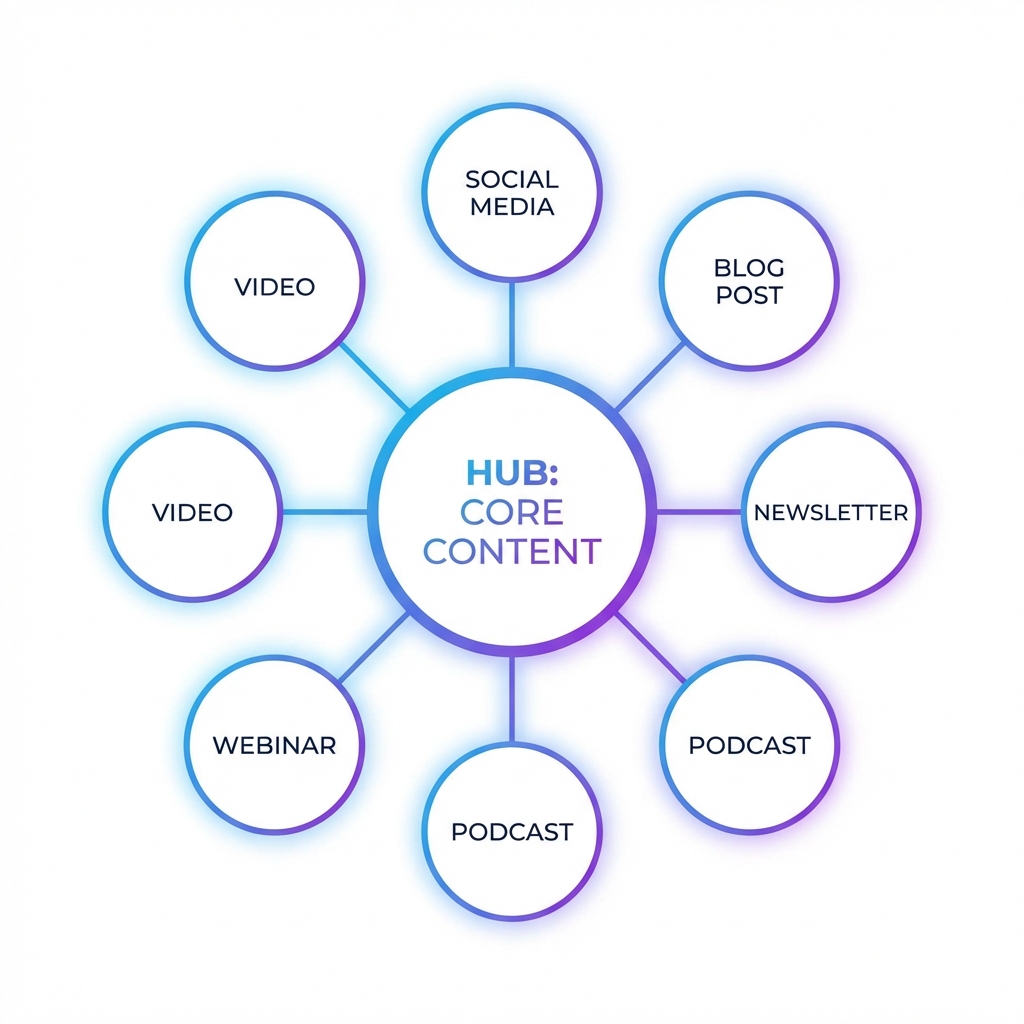
The Hub & Spoke model is the most efficient way to build this. You create one comprehensive "Hub" article on your core topic (e.g., "The Complete Guide to SEO for Pune Businesses") and surround it with 6–10 "Spoke" articles on specific sub-topics (e.g., "Local SEO for Pune Restaurants," "Technical SEO Audit Checklist India," etc.).
The internal link network signals to Google: "This website covers this topic from every angle." That is the exact signal that earns AIO citations.
Pillar 4: Core Web Vitals & Technical Crawlability
Google cannot cite what it cannot crawl and render efficiently. Technical SEO is foundational to AIO eligibility:
- LCP under 2.5 seconds. Aim for sub-2s on mobile. Indian users on 4G/5G connections need fast-loading pages, and slow LCP directly affects how frequently Googlebot re-crawls your content.
- Clean semantic HTML. Avoid JavaScript-only rendering for critical content. Googlebot still struggles with some JS-heavy pages, and unrendered content cannot be cited.
- Canonical and hreflang consistency. Duplicate content or incorrect hreflang tags confuse Google's entity resolution — it won't know which version of your page to attribute.
- Structured data coverage. Beyond
BlogPosting and FAQ schema, add
HowTo,LocalBusiness, andServiceschemas where relevant. More structured data = more machine-readable signals for AIO sourcing.
Pillar 5: Original Data, Local Insights & Genuine First-Party Experience
This is the most underutilized AIO advantage available to Indian agencies and businesses — and your largest competitive edge over global competitors.
Google's AI overwhelmingly favors content with:
- Original statistics and case study data. "In a recent audit of 15 Pune e-commerce sites, we found average LCP of 4.7 seconds" is infinitely more citable than "site speed is important for SEO." If you have client data (anonymized), use it.
- Local market specificity. Content that speaks to the Maharashtra / Pune / Deccan region business environment — local regulations, platform preferences (WhatsApp-first customer journeys, UPI-based funnels, Hinglish ad copy) — is genuinely unique and cannot be replicated by a global content farm.
- Named expert opinions and client quotes. Named quotes from real clients or industry peers, with schema attribution, are one of the strongest E-E-A-T signals Google evaluates for AIO sourcing.
"The Indian digital market is one of the few places where local expertise genuinely beats global scale in search. Use that advantage before your competitors figure it out."
AIO & Performance Marketing: The Combined Strategy
Here's a nuance most agencies miss: AIO optimization and performance marketing work together, not in competition.
While you build organic AIO authority (which takes 30–90 days), Google Ads for commercial-intent keywords ensures you're capturing revenue-ready leads today. And as your organic authority grows, your Google Ads Quality Scores improve — because Google rewards advertisers whose landing pages match high E-E-A-T signals. Lower CPC. Higher conversion. Both driven by the same content investment.
This is the compounding advantage of a unified SEO + Performance Marketing strategy — and why we structure every client engagement at VSS around both channels working in sync.
Your AIO Readiness Checklist for 2026
Run this checklist against your top 5 service pages and most recent blog posts:
Content & Structure
- ✓ Lead paragraph answers the primary query directly
- ✓ H2 headings are phrased as questions or definitive answers
- ✓ FAQ section with 4–6 questions + FAQPage schema
- ✓ At least one original stat, insight, or case data point
- ✓ Internal links to related topical cluster articles
E-E-A-T & Trust
- ✓ Named author with bio, photo, and author schema
- ✓ Organization schema on homepage/about page
- ✓ External citations (studies, data sources) linked
- ✓ Client proof or case study linked from content
Technical
- ✓ LCP under 2.5s on mobile
- ✓ BlogPosting schema with datePublished, author, headline
- ✓ Canonical URL set correctly
- ✓ No render-blocking JS hiding main content
Frequently Asked Questions
What are Google AI Overviews (AIO)?
Google AI Overviews are AI-generated summaries that appear at the top of search results, powered by Google's Gemini model. They synthesize answers from multiple high-authority sources and appear on roughly 47% of searches in India as of early 2026, significantly above the global average.
How do I get my website cited in Google AI Overviews?
Focus on five things: strong E-E-A-T signals, FAQ-structured content with schema markup, topical authority through a content cluster, fast Core Web Vitals, and original first-party data or insights. Businesses in Pune with local expertise have a structural advantage — use it.
Are Google AI Overviews hurting SEO traffic in India?
For top-of-funnel informational queries, yes — click-through rates are down 18–30%. But for commercial and local-intent searches ("SEO agency Pune," "Google Ads cost India"), businesses that are cited in AIO still receive significant traffic and brand trust gains. The strategy is to build for citation, not just ranking.
Does E-E-A-T still matter for SEO in 2026?
More than ever. Both Google's Helpful Content system and its AIO citation logic are deeply rooted in E-E-A-T. For Indian businesses, this means author bios, local credentials, client case studies, and original market insights are critical infrastructure — not optional extras.
How long does it take to rank in Google AI Overviews?
With a properly structured piece of content and existing domain authority, we typically see AIO citations appear within 30–90 days. For newer domains with thin content histories, the first step is building topical authority through a content cluster — usually a 3–6 month process before consistent AIO citations begin.
Conclusion: The Businesses That Will Win in AI-First Search
Google AI Overviews aren't a threat to good SEO — they are the natural endpoint of what authority-based SEO has always been building toward. The businesses that win will be the ones that invest in real expertise, real data, and real local relevance — not the ones gaming keyword density.
For Pune businesses, the opportunity is significant. Your local market knowledge, your first-hand client results, and your proximity to your customers are structural advantages that no Mumbai-headquartered agency with 500 generic blog posts can replicate.
The window to establish AIO authority before the market matures is open — but it won't stay open long. If you'd like to see exactly where your website stands against the AIO readiness checklist, our Growth Audit covers all five pillars and comes with a prioritized action plan.
Related Reading
The Hub & Spoke SEO Model
How to build topical authority that dominates both classic rankings and AI Overviews.
Google Ads vs Meta Ads in India
Which paid channel drives faster ROI while your organic authority compounds.
AI Content Scaling Without Losing Quality
How to use AI tools to produce AIO-ready content at volume — without sacrificing E-E-A-T.
Digital Marketing for Small Businesses in Pune
The complete 2026 playbook for Pune SMBs to compete with bigger budgets.